
Surgical Blade Sizes and Uses: A Comprehensive Guide
Surgical blades, available in sterile packaging, are categorized by size and shape. PDF resources detail blade numbers, like No. 10 and No. 20, for varied surgical needs.
Surgical scalpel blades represent a fundamental component within the surgical toolkit, essential for precise tissue incision and dissection. These blades, often referenced within comprehensive surgical blade sizes and uses PDF guides, are not merely cutting tools; they are instruments demanding a thorough understanding of their varied designs and applications.
The selection of an appropriate blade hinges on factors like the tissue type, incision depth, and surgical approach. Blades arrive in sterile packaging, ensuring patient safety, and are identified by a numbering system that correlates to both their size and shape. Common examples include the curved Blade No. 10, ideal for larger incisions, and the more robust Blade No. 20, suited for demanding procedures.
Manufacturers like Swann-Morton lead the industry, offering a diverse range of blades and handles, catering to general surgery, orthopedics, and specialized fields like veterinary medicine, podiatry, and dentistry. Understanding these nuances, often detailed in downloadable PDF charts, is crucial for optimal surgical outcomes.
Understanding Blade Numbering Systems
The surgical blade numbering system is a standardized method for identifying and categorizing scalpel blades, frequently detailed in surgical blade sizes and uses PDF resources. This system isn’t arbitrary; each number corresponds to a specific blade shape, size, and intended application. A PDF chart is often the best resource for quick reference.
Lower numbers generally indicate smaller blades designed for delicate procedures, such as ophthalmology, while higher numbers denote larger blades for more extensive surgeries like abdominal operations. For instance, Blade No. 10, a commonly used blade, features a large curved cutting edge. Conversely, Blade No. 15 is designed for precise, controlled incisions.
Furthermore, manufacturers like Swann-Morton utilize series – A and B – to indicate slight variations in blade design and manufacturing processes. These distinctions, outlined in their product documentation and PDF guides, impact blade performance and compatibility with specific handles (1, 3, and 7 are common). Understanding this system ensures surgeons select the optimal blade for each surgical task.
Swann-Morton Blade Series: A and B
Swann-Morton, a leading manufacturer, categorizes its surgical blades into two primary series: A and B. Detailed specifications are readily available in their comprehensive surgical blade sizes and uses PDF catalogs. These series aren’t simply labeling conventions; they represent subtle yet significant differences in blade geometry and manufacturing tolerances.
Generally, Series A blades are manufactured to tighter tolerances, resulting in a more refined cutting edge and potentially improved performance for precise procedures. Series B blades, while still meeting stringent quality standards, may offer a more cost-effective option for general surgical applications. A PDF comparison chart highlights these nuances.
The series designation is often indicated on the blade packaging and within Swann-Morton’s product literature. Understanding these distinctions allows surgeons to select blades tailored to the specific demands of their procedures. The choice between A and B series can impact factors like blade sharpness, durability, and overall surgical outcome, as detailed in their instructional PDF guides.
Blade No. 10: Characteristics and Applications
Blade No. 10 is a widely utilized surgical scalpel blade, frequently detailed in surgical blade sizes and uses PDF guides. It features a large, curved cutting edge with a flat back, representing a traditional blade shape. This geometry makes it exceptionally versatile for a broad range of surgical incisions.
Its primary application lies in making skin incisions and dissecting through soft tissues. The curved shape facilitates smooth, controlled cuts, minimizing tissue damage. Surgeons often employ Blade No. 10 for larger incisions where a substantial cutting length is required. Detailed illustrations in PDF resources showcase proper handling techniques.

Compatible handles for Blade No. 10 include handles 1, 3, and 7. The blade’s robust design ensures durability throughout the procedure. Comprehensive PDF manuals from manufacturers like Swann-Morton provide in-depth information on its characteristics, proper usage, and safety precautions, emphasizing its role in various surgical specialties.
Blade No. 10: Compatible Handles
Understanding Blade No. 10’s compatibility with scalpel handles is crucial, often detailed in surgical blade sizes and uses PDF documentation. This blade is designed to fit securely into a variety of standard scalpel handles, ensuring a stable and controlled cutting experience. The most commonly used handles are numbered 1, 3, and 7, each offering a slightly different grip and feel for the surgeon.
Handle No. 1 is a lightweight option, suitable for delicate procedures requiring precision. Handle No. 3 provides a more substantial grip, offering enhanced control during larger incisions. Handle No. 7 is often preferred for its ergonomic design and comfortable feel during prolonged surgeries. PDF guides from manufacturers like Swann-Morton illustrate the proper attachment and locking mechanisms for each handle type.
Ensuring a secure fit between the blade and handle is paramount for safety and optimal performance. Detailed diagrams within PDF resources demonstrate the correct insertion and release procedures, minimizing the risk of accidental blade dislodgement during operation.
Blade No. 10: Typical Uses in Surgery

Blade No. 10, as outlined in surgical blade sizes and uses PDF guides, is a versatile tool widely employed across numerous surgical specialties. Its large, curved cutting edge makes it ideal for creating substantial skin incisions, commonly utilized in general surgery, dermatological procedures, and even some orthopedic applications.
Specifically, Blade No. 10 excels in situations requiring long, smooth cuts through soft tissue, such as excising lesions, opening surgical sites, or performing large biopsies. Surgeons frequently employ it for initial skin incisions due to its efficient cutting ability. PDF resources often showcase its application in abdominal surgeries, where larger incisions are frequently necessary.
However, its use isn’t limited to large incisions; it can also be used for deeper tissue dissection when a broad cutting surface is needed. Detailed illustrations within PDF manuals demonstrate proper technique to maximize efficiency and minimize tissue trauma, ensuring optimal patient outcomes.
Blade No. 11: Features and Surgical Applications
Blade No. 11, as detailed in surgical blade sizes and uses PDF documentation, is a pointed scalpel blade known for its precision and control. Unlike the curved Blade No. 10, the No. 11 features a triangular shape with a sharp point, making it exceptionally suited for making precise, short incisions.
PDF guides highlight its frequent use in dermatological surgery for procedures like punch biopsies, excisions of small skin lesions, and precise suture placement. Ophthalmologists also favor Blade No. 11 for corneal incisions and other delicate eye surgeries, where accuracy is paramount. Its pointed tip allows for controlled penetration and minimal tissue disruption.
Furthermore, Blade No. 11 finds application in plastic surgery for creating precise incision lines and in pathology for obtaining small tissue samples. PDF resources emphasize the importance of proper handling to avoid accidental injury due to its sharp point, and demonstrate optimal techniques for achieving clean, accurate cuts.
Blade No. 12: Description and Common Procedures

Blade No. 12, as outlined in surgical blade sizes and uses PDF guides, is a relatively small blade with a curved shape and a pointed tip. It’s distinguished by its versatility, bridging the gap between the precision of a No. 11 and the broader cutting capacity of a No. 10. PDF documentation details its construction, often from high-quality stainless steel, ensuring durability and sharpness.
Commonly, Blade No. 12 is employed in dermatological procedures, including skin biopsies and excisions of smaller lesions. Its curved shape facilitates precise contouring along the skin, minimizing scarring. PDF resources also illustrate its use in plastic surgery for delicate tissue dissection and flap elevation.
Furthermore, Blade No. 12 is frequently utilized in Mohs micrographic surgery, a specialized technique for removing skin cancer layer by layer. The blade’s shape allows surgeons to accurately map and excise cancerous tissue while preserving healthy skin. PDFs emphasize proper blade attachment and safe handling techniques for optimal results.
Blade No. 15: Design and Specific Uses
Blade No. 15, detailed in surgical blade sizes and uses PDF charts, features a small, triangular shape with a robust, slightly curved cutting edge. This design distinguishes it as a heavy-duty blade, despite its relatively small size. PDF resources highlight its construction from durable stainless steel, ensuring resilience during demanding procedures.
Its primary application, as outlined in PDF guides, lies in orthopedic surgery, specifically for procedures involving tendons, ligaments, and joint capsules. The blade’s strength allows for controlled incisions through tougher tissues. It’s also frequently used in arthroscopic procedures, where precision and durability are paramount.
Furthermore, Blade No. 15 finds utility in podiatric surgery for procedures like tenotomies and ligament releases. PDF documentation emphasizes the importance of proper blade selection based on tissue type and surgical approach. Variations like Blade No. 15C offer slight modifications to the angle and curvature, expanding its versatility.
Blade No. 15C: A Variation of Blade No. 15
Blade No. 15C, as detailed in surgical blade sizes and uses PDF guides, represents a refined variation of the standard Blade No. 15. The key distinction lies in its curved shape and a slightly more acute angle of the cutting edge. PDF resources illustrate this difference, showcasing how it alters the blade’s handling and incision characteristics.
This modification, highlighted in PDF documentation, enhances its suitability for specific surgical tasks. It excels in procedures requiring a more precise and controlled cutting action, particularly in areas with limited access. The curvature facilitates maneuvering within tight spaces, improving surgical efficiency.
Blade No. 15C maintains the robust construction of its predecessor, ensuring durability during demanding procedures. PDF charts often recommend it for delicate dissections and precise tissue removal. It’s commonly employed in orthopedic and podiatric surgeries, offering surgeons an alternative with enhanced maneuverability and control.
Blade No. 20: Size and Robust Applications

Blade No. 20, as outlined in surgical blade sizes and uses PDF documentation, is notably larger than the commonly used Blade No. 10. It features a curved cutting edge, similar in design, but is engineered for more demanding surgical applications. PDF resources emphasize its increased robustness and ability to handle thicker tissues effectively.
This blade’s size and shape, detailed in PDF guides, make it particularly well-suited for procedures requiring substantial cutting force. It’s frequently utilized in general surgeries, where larger incisions are necessary, and in certain orthopedic procedures involving dense tissues. The curved edge allows for efficient and controlled tissue dissection.
PDF charts often highlight its compatibility with handles 1, 3, and 7. Surgeons appreciate its durability and consistent performance. The Blade No. 20 is a valuable tool when a more substantial blade is required for optimal surgical outcomes, as detailed in comprehensive surgical blade references.
Blade No. 20: Use in General and Orthopedic Surgery
Surgical blade sizes and uses PDF guides consistently demonstrate Blade No. 20’s prominence in both general and orthopedic surgical settings. In general surgery, its larger size and robust cutting edge facilitate efficient incision through various tissue layers during exploratory procedures and resections. PDF documentation details its effectiveness in creating larger wound openings.
Orthopedic surgeons frequently employ Blade No. 20 when dealing with denser tissues, such as muscle and fascia, during joint replacements or fracture repairs. PDF resources illustrate its utility in subperiosteal dissections and ligament releases. The blade’s curved shape allows for precise tissue management.
PDF charts often showcase its suitability for procedures demanding significant cutting power. Surgeons value its ability to maintain sharpness throughout extended use; Proper handling, as outlined in surgical blade safety PDFs, is crucial for optimal performance and patient safety during these demanding applications.
Smaller Blades for Delicate Procedures
Surgical blade sizes and uses PDF resources highlight the critical role of smaller blades in procedures demanding precision and minimal tissue trauma. These blades, often referenced in detailed PDF guides, are essential for specialties like ophthalmology, dermatology, and plastic surgery. Their diminutive size allows for intricate incisions with reduced risk of damaging surrounding structures.
PDF documentation illustrates how blades like No. 15 and its variations (15C) excel in creating superficial skin excisions and precise biopsies. The fine point facilitates accurate placement and controlled depth. PDF charts often compare blade geometries to demonstrate optimal choices for specific tasks.
Furthermore, surgical blade selection PDFs emphasize the importance of matching blade size to the delicacy of the procedure. Smaller blades minimize scarring and promote faster healing, crucial considerations in cosmetic and reconstructive surgeries. Proper technique, detailed in safety PDFs, ensures optimal outcomes.
Surgical Blade Materials: Stainless Steel vs. Carbon Steel
Surgical blade sizes and uses PDF guides comprehensively detail the material composition of blades, primarily focusing on stainless steel and carbon steel. PDF resources explain that stainless steel offers excellent corrosion resistance, crucial for maintaining sterility and extending blade lifespan, as detailed in instrument care PDFs.
Conversely, PDF documentation highlights that carbon steel achieves a superior sharpness, allowing for cleaner, more precise incisions. However, this enhanced sharpness comes at the cost of increased susceptibility to corrosion, necessitating careful handling and sterilization procedures outlined in safety PDFs.

PDF charts often compare the properties of each material, including hardness, flexibility, and edge retention. The choice between stainless and carbon steel depends on the specific surgical application and surgeon preference, as detailed in selection PDFs. Modern surgical blades increasingly utilize advanced stainless steel alloys to balance sharpness and durability.
Sterile Packaging and Blade Integrity
Surgical blade sizes and uses PDF documents emphasize the critical importance of sterile packaging in maintaining blade integrity. PDF guides detail how blades are individually sealed to prevent contamination, adhering to strict ISO 447:1984 standards, as referenced in quality control PDFs.
The packaging serves as a barrier against microorganisms, ensuring patient safety during surgical procedures. PDF resources illustrate proper package inspection protocols – checking for tears, punctures, or compromised seals before use. Maintaining this sterility is paramount, as outlined in infection control PDFs.
PDF charts often depict the layers of protective packaging and sterilization indicators. Blade integrity, including sharpness and shape, is also preserved within the sterile environment. Single-use, sterile blades like ENSENT are designed to be discarded after one procedure, further minimizing risk, as detailed in disposal PDFs.
Selecting the Appropriate Blade Size
Surgical blade sizes and uses PDF guides are essential for clinicians when choosing the correct blade. PDF resources highlight that blade selection depends heavily on the surgical procedure and tissue type. Smaller blades, detailed in PDF charts, are ideal for delicate surgeries like ophthalmology, while larger blades, like No. 20, suit extensive operations.
PDF documents emphasize considering incision length and depth. A No. 10 blade, described in PDF specifications, is versatile for skin and muscle incisions. PDFs often include comparative tables outlining blade shapes – curved versus straight – and their respective applications.
Understanding Swann-Morton blade series (A and B), as explained in manufacturer PDFs, is crucial. The PDFs also stress the importance of matching the blade to the appropriate handle (1, 3, 7 for No. 10). Proper selection minimizes tissue trauma and optimizes surgical outcomes, as detailed in best-practice PDFs.

Blade Attachment and Safe Handling
Surgical blade sizes and uses PDF guides consistently emphasize safe handling protocols. PDF resources detail the correct method for securely attaching a blade to its handle, preventing accidental detachment during surgery. Proper attachment, illustrated in many PDFs, ensures stability and control.
PDF documents stress the importance of a firm grip and controlled movements when using a scalpel. They advise against applying excessive force, which can cause the blade to slip or break. PDFs often include diagrams demonstrating proper cutting techniques.
Safe disposal of used blades is a critical component, detailed in hospital PDF safety manuals. PDFs recommend utilizing designated sharps containers to prevent needlestick injuries and contamination. Always refer to the manufacturer’s PDF instructions for specific blade handling and disposal guidelines, ensuring a safe surgical environment.
Indications for Scalpel and Blade Use
Surgical blade sizes and uses PDF documents outline a broad spectrum of applications. Scalpels and blades are indicated for precise incisions in various surgical specialties, including general surgery, dermatology, and ophthalmology. PDF guides detail blade selection based on tissue type and incision depth.

PDF resources highlight the use of larger blades, like No. 20, for robust applications in general and orthopedic surgeries, while smaller blades are preferred for delicate procedures. PDFs emphasize that scalpels are essential for excising lesions, draining abscesses, and performing biopsies.
Veterinary, podiatry, and dentistry also rely heavily on scalpels, as detailed in specialized PDF manuals. PDFs consistently stress the importance of selecting an instrument suitable for the specific purpose, ensuring optimal surgical outcomes and minimizing patient trauma. Always consult relevant PDF guidelines before use.
Veterinary, Podiatry, and Dentistry Blade Applications

Surgical blade sizes and uses PDF resources demonstrate specialized applications beyond human medicine. In veterinary surgery, blades are crucial for spaying/neutering, wound repair, and tumor removal, with PDFs detailing appropriate blade choices for different animal sizes and tissue types.
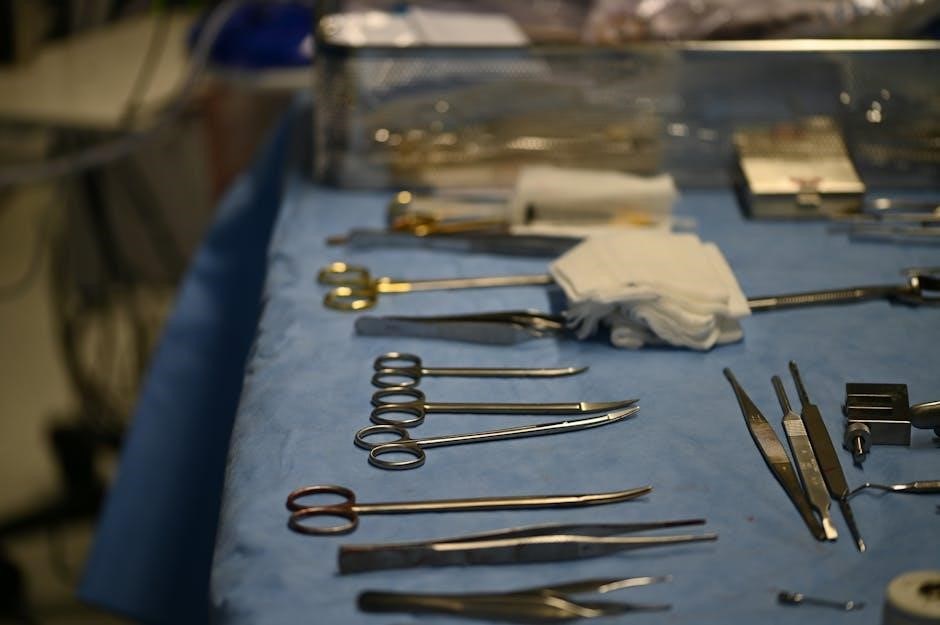
Podiatry utilizes scalpels for procedures like corn and callus removal, nail avulsions, and soft tissue biopsies; PDF guides specify blade angles and sizes for optimal foot and ankle surgery. Dentistry employs blades for gingivectomies, frenectomies, and biopsy procedures, as outlined in dedicated PDF manuals.
PDF documentation from manufacturers like Swann-Morton highlights specific blade series (A & B) and sizes tailored to these fields. These PDFs emphasize the need for sterile, single-use blades to prevent cross-contamination. Proper blade selection, as detailed in these PDFs, is vital for successful outcomes.
ISO 447:1984 Standards for Surgical Blades
ISO 447:1984 establishes international standards for surgical blades, ensuring consistency in manufacturing and performance. Surgical blade sizes and uses PDF documents often reference this standard, detailing specifications for blade geometry, materials, and sterilization. The standard covers blade shape, dimensions, and material composition – typically stainless steel or carbon steel.
Compliance with ISO 447:1984 guarantees interchangeability between blades and handles from different manufacturers. PDF resources from suppliers like Swann-Morton confirm adherence to these standards. The standard also addresses blade marking requirements, including blade number and series (A or B).
Detailed PDF charts illustrate how ISO 447:1984 impacts blade design and functionality. Understanding these standards is crucial for surgeons and procurement professionals, ensuring quality and safety. Manufacturers’ PDF catalogs often include declarations of conformity to ISO 447:1984.
Single-Use Sterile Surgical Blades: ENSENT
ENSENT offers a comprehensive range of single-use sterile surgical blades, designed for enhanced safety and efficiency. Their product line encompasses various sizes, including No. 10, No. 11, No. 12, No. 15, and No. 15C, catering to diverse surgical procedures. Surgical blade sizes and uses PDF guides often feature ENSENT blades alongside their applications.
These blades are constructed from high-quality stainless steel, ensuring sharpness and durability. ENSENT’s sterile packaging maintains blade integrity, minimizing the risk of infection. PDF documentation highlights the benefits of single-use blades, such as eliminating sterilization costs and reducing cross-contamination.
ENSENT blades are compatible with standard scalpel handles. Detailed PDF specifications are available, outlining blade dimensions and material properties. Choosing ENSENT provides surgeons with reliable, sterile instruments, contributing to optimal patient outcomes. Their catalog PDFs are readily accessible online.
Resources for Surgical Blade Information (PDFs & Charts)
Numerous online resources provide detailed information on surgical blade sizes and uses in PDF format. Swann-Morton, a leading manufacturer, offers comprehensive catalogs and charts outlining their A and B series blades, including specifications and applications. These PDFs detail blade geometry, compatible handles, and recommended surgical uses.
ISO 447:1984 standards for surgical blades are often included in downloadable PDF documents, ensuring adherence to international quality guidelines. Manufacturers like ENSENT also provide PDFs showcasing their range of single-use sterile blades, with size charts and material information.
Surgical supply companies frequently host downloadable PDF guides comparing different blade types and their suitability for specific procedures. These resources are invaluable for surgeons and surgical technicians seeking to optimize blade selection and ensure safe, effective patient care. Accessing these PDFs streamlines the learning process.
Future Trends in Surgical Blade Technology
The evolution of surgical blade technology is focused on enhancing precision, safety, and efficiency. Current research explores advanced materials beyond traditional stainless steel and carbon steel, aiming for improved sharpness and reduced tissue trauma. PDF resources detailing these innovations are emerging from research institutions and manufacturers.
Single-use sterile blades, like those from ENSENT, are expected to become even more prevalent, driven by infection control concerns and streamlined surgical workflows. Developments in blade coatings are also underway, potentially minimizing drag and improving cutting performance. PDF guides will reflect these changes.
Furthermore, integration with robotic surgical systems is driving demand for specialized blade designs and automated blade changing mechanisms. Expect to see more detailed PDF documentation outlining compatibility and optimal usage parameters for these advanced systems, alongside evolving ISO standards.